

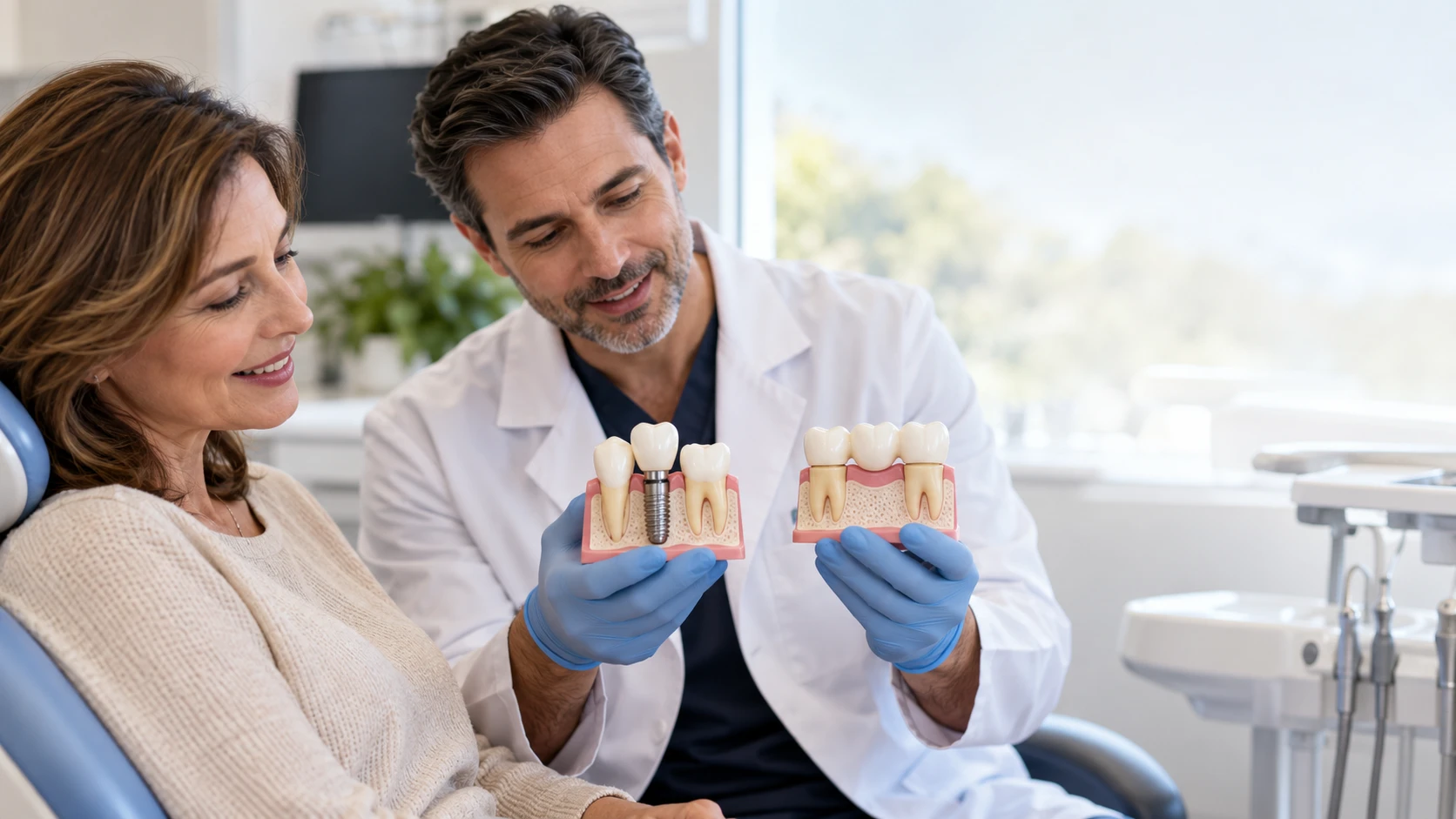
Losing a single tooth can feel like a surprisingly big change.
You may notice the gap every time you smile or laugh. Chewing on that side may become uncomfortable, and over time, the teeth around the empty space may begin to shift. Bone changes can also occur where the tooth and its root are no longer present. The American Dental Association notes that missing teeth can affect eating and chewing, while surrounding teeth may shift and bone loss can occur in some cases.
Fortunately, a missing tooth does not have to remain missing.
Two of the most established options are a single-tooth dental implant and a traditional fixed dental bridge. Both can restore the appearance and function of your smile, but they accomplish that in very different ways.
For patients comparing a dental bridge vs. implant in Orinda, the right decision depends on the health of your neighboring teeth, available jawbone, overall health, bite, budget, treatment timeline, and long-term priorities.
Here is what you should know before choosing.
What Is a Dental Bridge?
A traditional fixed bridge literally bridges the space created by a missing tooth.
For a single missing tooth, a conventional bridge commonly consists of three connected units. The artificial tooth in the middle, called a pontic, fills the empty space. It is supported by crowns placed over the natural teeth on either side of the gap.
Unlike a removable appliance, a fixed bridge remains in your mouth and can only be removed by a dental professional.
What Are the Advantages of a Dental Bridge?
One of the biggest advantages is that treatment does not require implant surgery.
A bridge can also usually be completed more quickly than an implant because there is no need to wait several months for an implant to integrate with the jawbone.
Other potential advantages include:
- No implant surgery
- A relatively predictable restorative procedure
- Faster overall treatment in many cases
- Natural-looking porcelain or ceramic options
- Often a lower initial investment than implant treatment
- Particularly useful when neighboring teeth already need crowns
Modern digital dentistry can also make the process more efficient. Orinda Dental Care uses digital scanning and CEREC technology for restorative treatment, allowing certain dental crowns to be designed and fabricated in the office.
What Is the Trade-Off With a Bridge?
The main consideration is what happens to the neighboring teeth.
With a conventional bridge, the teeth on either side of the gap must be prepared to receive crowns. That means some natural tooth structure is permanently removed, even if those teeth were otherwise healthy.
Those supporting teeth then become responsible for helping support the replacement tooth.
A bridge also replaces the visible portion of the missing tooth, but it does not replace the root within the jawbone. As a result, it does not provide the same type of stimulation to the bone at the missing-tooth site that an implant can.
Cleaning is another consideration. Because the artificial tooth is connected to the crowns on either side, you cannot floss straight down between the units as you would between separate natural teeth. Special floss threaders, interdental brushes, or other cleaning tools may be recommended to clean underneath the bridge.
Bridges can provide many years of service, but their longevity depends on oral hygiene, bite forces, the condition of the supporting teeth, and other individual factors. Eventually, a bridge may require repair or replacement.
What Is a Single-Tooth Dental Implant?
A dental implant approaches the problem differently by replacing the missing tooth independently rather than relying on neighboring teeth.
A typical single-tooth implant restoration consists of three components:
- The implant: A biocompatible post, most commonly made from titanium, that is surgically positioned in the jawbone.
- The abutment: A connector attached to the implant.
- The crown: A custom restoration designed to resemble the missing natural tooth.
The American Dental Association describes implants as posts made from titanium and other biocompatible materials that are surgically placed in the jaw, where they serve as anchors for replacement teeth.
Why Does Osseointegration Matter?
After an implant is placed, the surrounding bone heals around it through a process called osseointegration.
In simple terms, the implant becomes integrated with the jawbone, creating a stable foundation for the replacement tooth.
This healing process takes time. Depending on the patient's circumstances, several months may be needed before the final restoration is attached, although treatment protocols differ from one case to another.
Once healing is complete, a custom crown can be connected to the implant.
The Major Advantage: Your Neighboring Teeth Stay Independent
For many patients, this is one of the most important differences between an implant and a traditional bridge.
A single-tooth implant does not normally require the healthy teeth on either side of the missing tooth to be prepared for crowns.
Each tooth remains independent.
This can be especially appealing when the neighboring teeth are healthy, intact, and do not otherwise need restorative treatment.
For someone looking to replace a missing tooth in Lamorinda, preserving healthy tooth structure can be an important part of the long-term treatment discussion.
Dental Implant vs. Bridge: How Do They Compare?
Neither treatment should be selected based on one factor alone. Here are some of the differences worth discussing with your dentist.
1. Impact on Neighboring Teeth
With an implant: The restoration is supported independently by the implant in the jawbone. Healthy neighboring teeth generally do not need to be reduced simply to support the missing tooth.
With a traditional bridge: The adjacent teeth are prepared for crowns and become part of the bridge.
If those neighboring teeth are completely healthy, preserving them may favour considering an implant. If they already have large restorations, cracks, or other problems that require crowns, a bridge may become more reasonable.
2. Jawbone Preservation
A natural tooth root transfers functional forces into the surrounding jawbone.
After a tooth is removed, changes in the bone can occur because that root is no longer present.
An implant is positioned within the jawbone and transfers forces during function. This is one reason implants are often discussed in connection with maintaining bone at a missing-tooth site.
A conventional bridge sits above the missing-tooth area and is supported by neighboring teeth, so it does not replace the missing root.
However, individual bone response varies. An examination and appropriate imaging are necessary to evaluate the site properly.
3. Long-Term Durability and Value
It is tempting to compare treatments using a simple number of years, but that can create unrealistic expectations.
Both bridges and implants can provide long-term service when appropriately planned and maintained.
An implant itself can remain functional for many years, but the crown attached to it may eventually require maintenance or replacement. Implant longevity also depends on gum and bone health, oral hygiene, smoking status, bite forces, medical factors, and regular professional care.
A bridge can also last many years, but its future depends partly on the health of the supporting teeth. Decay, fractures, gum disease, or problems beneath either supporting crown can affect the entire restoration.
This is why the initial price and long-term value are not necessarily the same thing.
An implant generally involves a higher initial investment and a longer treatment process. A bridge may have a lower upfront cost and shorter timeline, but future replacement and the health of the supporting teeth should be considered when comparing long-term costs.
4. Daily Maintenance
A single implant crown is separate from the neighboring teeth, allowing you to clean between the teeth more naturally. Good brushing, interdental cleaning, and professional maintenance remain essential because implants can still develop problems in the surrounding gums and bone.
A bridge also requires excellent hygiene, but cleaning underneath the artificial tooth usually requires an additional technique or specialized cleaning aid.
Neither treatment is maintenance-free.
When Might a Dental Bridge Still Make Sense?
Dental implants offer important advantages, but that does not mean every missing tooth should automatically be replaced with an implant.
A bridge may make sense when:
- The neighboring teeth already require crowns.
- A patient prefers to avoid implant surgery.
- Medical considerations affect suitability for implant surgery or healing.
- There is inadequate bone for straightforward implant placement and the patient does not want additional grafting procedures.
- Treatment time is an important consideration.
- Financial circumstances make a bridge more practical.
There are also situations where anatomy, bite forces, gum health, or the location of the missing tooth can influence the recommendation.
Similarly, not everyone is immediately ready for implant placement. The American Dental Association notes that general health, chronic illnesses, tobacco use, and other factors can influence healing and implant candidacy.
The goal should not be to declare one treatment universally superior. It should be to determine which option makes the most clinical sense for the individual patient.
What If You Are Facing an Extraction?
If you have been told that a tooth may need to be removed, discussing replacement before the extraction whenever possible can be helpful.
Your dentist can evaluate the tooth, surrounding bone, gums, neighboring teeth, and bite while planning what comes next.
Depending on your situation, treatment planning may involve evaluating whether immediate implant placement is possible, whether the extraction site should heal first, or whether bone preservation or grafting should be considered.
Planning ahead can help you understand the complete treatment process rather than making decisions one procedure at a time.
Restorative and Implant Dentistry at Orinda Dental Care
Choosing between a bridge and an implant requires more than looking at the empty space.
Your dentist needs to consider the condition of the neighboring teeth, available bone, gum health, bite forces, aesthetic requirements, and how the proposed restoration will function with the rest of your smile.
At Orinda Dental Care, Dr. Morgan Mehranfard brings more than 14 years of clinical experience to restorative care. The practice provides dental implants as well as crown and bridge treatment, allowing patients to discuss multiple approaches to replacing missing teeth rather than starting with a predetermined solution.
The office also incorporates modern digital technology into patient care. Digital scanning can capture detailed 3D information about the teeth and bite without relying exclusively on traditional impression materials, while CEREC technology is available for same-day ceramic restorations in appropriate cases.
Most importantly, treatment planning should be personal.
Patients considering restorative dental care in Orinda can have their individual needs evaluated before deciding whether an implant, bridge, or another treatment approach is appropriate.
Orinda Dental Care welcomes patients from Orinda, Lafayette, Moraga, and communities throughout the East Bay in a comfortable, patient-focused setting.
Frequently Asked Questions
Is an Implant More Painful Than Getting a Bridge?
Implant placement is a surgical procedure, while preparing teeth for a conventional bridge is not implant surgery. Local anesthesia is used to keep patients comfortable during treatment.
Post-treatment experiences vary depending on the procedure and individual patient. Your dentist can explain what to expect and provide specific aftercare instructions.
Can I Get an Implant Immediately After an Extraction?
Sometimes, but not always.
Immediate implant placement depends on factors such as the condition of the extraction site, available bone, infection, gum health, implant stability, and the location of the tooth.
In other cases, the site may need time to heal before implant placement.
How Do I Know If I Have Enough Bone for an Implant?
This cannot be determined reliably by looking at the gap alone.
A clinical examination and appropriate dental imaging are needed to evaluate the dimensions and condition of the bone, nearby anatomical structures, gum health, and overall implant site.
If there is not enough bone for predictable implant placement, additional procedures may sometimes be considered.
Find the Right Way to Replace Your Missing Tooth in Orinda
A missing tooth may seem like a small space, but replacing it involves several important decisions.
A dental bridge can provide an attractive, fixed solution without implant surgery and may be particularly appropriate when neighboring teeth already need restorative treatment.
A single-tooth implant offers an independent replacement that does not normally require preparing healthy adjacent teeth and provides a root-like foundation within the jawbone.
There is no one-size-fits-all answer.
The most appropriate treatment depends on your bone structure, gum health, neighboring teeth, bite, medical history, timeline, and priorities. An in-person examination and appropriate digital imaging are the best way to understand those factors.
If you are considering a single-tooth implant in Orinda, CA, or want to compare an implant with a dental bridge, schedule a personalized tooth-replacement consultation with Dr. Morgan at Orinda Dental Care.
Call (925) 254-3725 or schedule an appointment online to take the next step toward restoring your smile.